
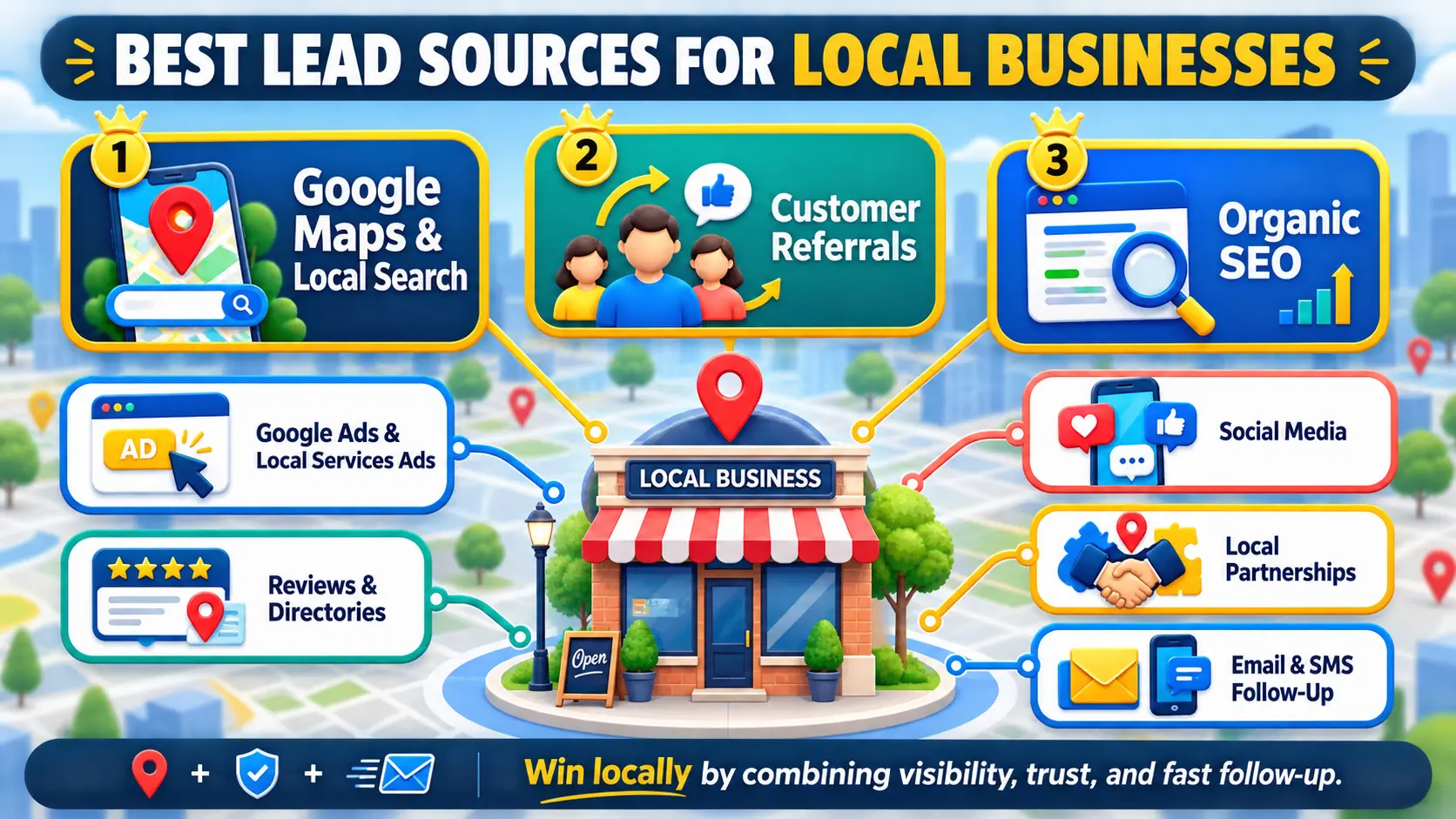
best lead sources for local businesses
Best lead sources for local businesses is best approached as a practical system designed to choose and measure a resilient mix of local lead channels. It combines technical accessibility, explicit entities, answer-first content, credible evidence, and measurement. The objective is not to manipulate an AI model; it is to make the most useful and defensible information easy to discover, understand, retrieve, verify, and represent accurately.
Key takeaways
- Center the page on one clear intent: choose and measure a resilient mix of local lead channels.
- Build coverage around local lead generation, organic search, paid search, referrals.
- Connect visible claims to accountable sources and the relevant Google Maps, Google Business Profile, Local Services Ads.
- Measure repeated outcomes and business impact instead of relying on a single AI response.
The best source depends on the decision
Local search and maps are powerful when a customer already needs a nearby provider. Referrals can convert well because trust transfers from the person making the introduction. Organic content captures research demand, while paid search and Local Services Ads can create immediate visibility for high-intent queries.
No single channel is best for every business. Ticket size, urgency, repeat purchase behavior, sales capacity, geography, and competition all change the economics.
Build visibility and trust together
A prospect may discover a company through an AI answer, verify it in maps, read reviews, visit the website, and then ask a colleague before contacting the business. Channel reporting should recognize that the path is often assisted rather than linear.
- Maps and local search for immediate local intent
- Referrals and partnerships for transferred trust
- Organic SEO and AEO for research and discovery
- Paid search for controllable high-intent reach
- Reviews, email, and SMS for trust and follow-up
Measure the complete lead system
Track source, qualified-lead rate, close rate, revenue, response time, and customer value. Call tracking and consistent form attribution can reveal when apparent volume does not translate into useful opportunities.
A resilient local-growth plan combines owned visibility, independent reputation, selective paid reach, and fast follow-up. The website remains the place where scattered signals become a credible decision experience.
Understand the local evidence graph
Local answers combine business identity, geography, service relevance, availability, reputation, and prominence. Google Maps, Google Business Profile, Local Services Ads, Google Ads may contribute different pieces of that evidence. The website remains important because it can explain services, locations, policies, proof, and ownership more completely than a short profile or directory listing.
For best lead sources for local businesses, consistency is the starting point. Names, addresses, phone numbers, hours, categories, and service areas should agree across authoritative sources. Consistency does not mean duplicating thin descriptions everywhere; it means maintaining the same facts while giving each platform useful, accurate context.
Build pages and proof for real markets
Create useful pages for genuine locations and distinct services. Explain who the service is for, the problems addressed, process, qualifications, availability, and relevant local examples. Avoid doorway pages that swap city names without adding local value. A service-area business should be transparent about where it operates and should not invent offices.
Reviews, project examples, original photos, local memberships, and independent coverage can strengthen local lead generation, organic search, paid search, referrals, conversion rate. Follow each platform's policies and never fabricate, gate, or script customer sentiment. The goal is a credible evidence trail that helps a person make a decision and gives an answer engine defensible source material.
Measure leads, not isolated rankings
Track implicit local queries, explicit city queries, service-specific questions, emergency needs, and comparison prompts separately. Record map visibility, organic visibility, AI mentions, cited URLs, calls, forms, bookings, qualified leads, and revenue. Proximity and personalization mean one rank from one location cannot represent an entire market.
Review channel interactions as well. A customer may discover the business in an AI answer, verify reviews in maps, visit a service page, and convert after a referral. Use call tracking, form attribution, customer interviews, and CRM outcomes to understand that journey. This makes best lead sources for local businesses accountable to business value.
A 90-day implementation roadmap
During days 1–30, establish the baseline for best lead sources for local businesses. Inventory the pages, profiles, and third-party sources that currently shape the topic. Test the five FAQ questions in this guide across the platforms relevant to the audience. Record inaccurate facts, missing citations, weak landing pages, intent overlap, and technical access issues. Assign one accountable owner to every finding and preserve the original observations so later comparisons are meaningful.
During days 31–60, improve the evidence closest to the decision. Rewrite unclear openings, add appropriate qualifications, connect claims to primary sources, strengthen internal links, and make Google Maps, Google Business Profile, Local Services Ads, Google Ads explicit where they genuinely belong. Align titles, descriptions, headings, visible content, images, and structured data. Consolidate pages that compete for the same intent, but preserve distinct pages that answer a materially different audience need.
During days 61–90, publish the completed improvements, verify indexing, and repeat the benchmark. Compare changes in local lead generation, organic search, paid search, referrals with search impressions, cited URLs, qualified visits, and conversions. Document what changed, what did not, and which external factors may have influenced the result. Use that evidence to choose the next topic rather than expanding the program through unsupported assumptions.
What a strong result looks like
Success means the page gives a person a complete, accurate answer and gives a retrieval system a clear, verifiable source. The brand is described consistently, important entities are unambiguous, cited pages match the user's intent, and the next action is easy to understand. For best lead sources for local businesses, improvement should appear as a pattern across repeated tests and business outcomes—not as one favorable screenshot. Maintain the page when evidence changes, disclose limitations, and keep the public record stronger than the markup describing it. Review the result with editorial, technical, analytics, and customer-facing teams because each group sees different evidence gaps and can prevent a narrow optimization from damaging the overall experience.
Frequently asked questions
What is the best lead source for a local business?
The practical definition centers on best lead sources for local businesses: choose and measure a resilient mix of local lead channels. Treat it as a connected program involving accessible pages, clear entities, useful answers, and evidence that people and retrieval systems can verify. The exact implementation depends on the audience, query, market, and platform.
Are referrals better than paid search?
Start with the highest-value questions and the pages that should answer them. Confirm technical access, align each page to one intent, strengthen local lead generation, organic search, paid search, and connect material claims to reliable evidence. Expand only after the core facts and conversion path are accurate.
How should local lead quality be measured?
Use the approach when it improves clarity for a reader as well as a machine. Google Maps, Google Business Profile, Local Services Ads can help reveal gaps, but no single platform should define the entire strategy. Keep visible content, metadata, internal links, and structured data consistent with one another.
What role does AEO play in lead generation?
No tactic can guarantee a ranking, citation, or recommendation. Avoid hidden content, invented credentials, unsupported schema, mass-produced pages, and mechanical keyword repetition. Durable performance comes from accurate source material, independent corroboration, a usable site, and repeated measurement across a representative query set.
How many lead channels should a business use?
Review results after meaningful site or market changes and on a scheduled cadence. Track cost per lead, lead quality, marketing attribution alongside leads or other business outcomes. Preserve the date, platform, prompt, and cited URLs so changes can be compared without confusing normal response variation with causation.
Related entities and concepts
Primary references
We use official documentation for platform and markup guidance, then separate those documented requirements from our editorial interpretation and observed testing.
This guide is educational and does not promise placement in any search or AI product. Platform behavior changes; verify current requirements before implementation. Our team reviews material claims, visible FAQs, links, and structured data together.