
01
Be understood
Build a clear entity footprint so answer engines know who you are, what you do, and where you are relevant.
Entity clarity ↗Answer Engine Optimization helps your business become the source AI systems understand, trust, and cite.
People now ask complete questions and expect complete answers. AI Overviews, assistants, and conversational search synthesize information before a customer ever reaches a website.
AEO is the discipline of making your brand eligible for that answer. It combines technical accessibility, entity clarity, expert content, structured information, and off-site authority.
Answer Engine Optimization makes a business easier for AI-powered search systems to understand, verify, retrieve, and cite. It strengthens the complete evidence trail around a brand: the website, entities, expert content, structured data, reviews, profiles, publications, communities, and other trustworthy sources that help an answer engine decide what is safe and useful to represent.
AEO does not replace search engine optimization. Crawlability, indexability, search intent, internal links, page experience, and people-first content remain foundational. AEO extends that work to passage-level answers, entity relationships, source corroboration, and brand representation across generative search systems.
Answer engines reward brands that are easy to interpret, safe to trust, and useful to quote.
Build a clear entity footprint so answer engines know who you are, what you do, and where you are relevant.
Entity clarity ↗Support every important claim with expert content, consistent facts, reviews, references, and third-party proof.
Authority signals ↗Structure pages around real questions, concise answers, original evidence, and passages machines can retrieve.
Answer readiness ↗Your website is the source of truth. Search engines, publications, profiles, reviews, communities, and structured data reinforce it. Consistency turns scattered mentions into machine-readable confidence.
A durable AEO program aligns technical access, content, entities, authority, and measurement around the questions that influence a customer decision.
Important information should exist in crawlable, server-rendered text on a stable canonical URL. Use descriptive titles, one clear H1, logical headings, meaningful internal links, accurate image alternatives, and a sitemap that points search systems to the preferred pages.
Robots directives should match the organization’s goals. Relevant crawlers cannot retrieve blocked evidence. Technical access creates eligibility; it does not guarantee selection.
Audit technical access →Define the organization, responsible people, services, products, locations, and areas of expertise in visible language. Keep names, contact details, descriptions, and relationships consistent across the website and authoritative external profiles.
Use Schema.org JSON-LD to reflect visible facts with stable identifiers. Choose page-specific types such as Organization, WebSite, WebPage, Article, ImageObject, BreadcrumbList, LocalBusiness, Service, or Person only when the page genuinely represents them.
Strengthen entity clarity →Open with a concise answer, then explain reasoning, exceptions, methods, and next steps. Strong pages contribute something beyond a summary: original data, first-hand experience, expert explanation, useful comparisons, local proof, demonstrations, or a transparent process.
E-E-A-T is demonstrated through accountable authorship, editorial review, sourcing, corrections, ownership, and contact information. Independent publications, reviews, reference sources, and relevant communities can corroborate important claims.
Apply E-E-A-T to AEO →AI visibility is probabilistic. The same prompt can produce different answers and citations because of location, personalization, model updates, retrieval systems, and conversational context. Use a stable prompt set and record the platform, date, answer, mentioned brands, citations, sentiment, and factual accuracy.
Report mentions, citations, recommendation share, cited pages, competitors, and source overlap alongside search impressions, qualified visits, conversions, and revenue. One favorable screenshot is not a measurement system.
Build an AEO measurement system →Three visual models turn AEO from an abstract idea into a system your team can understand, build, and measure.
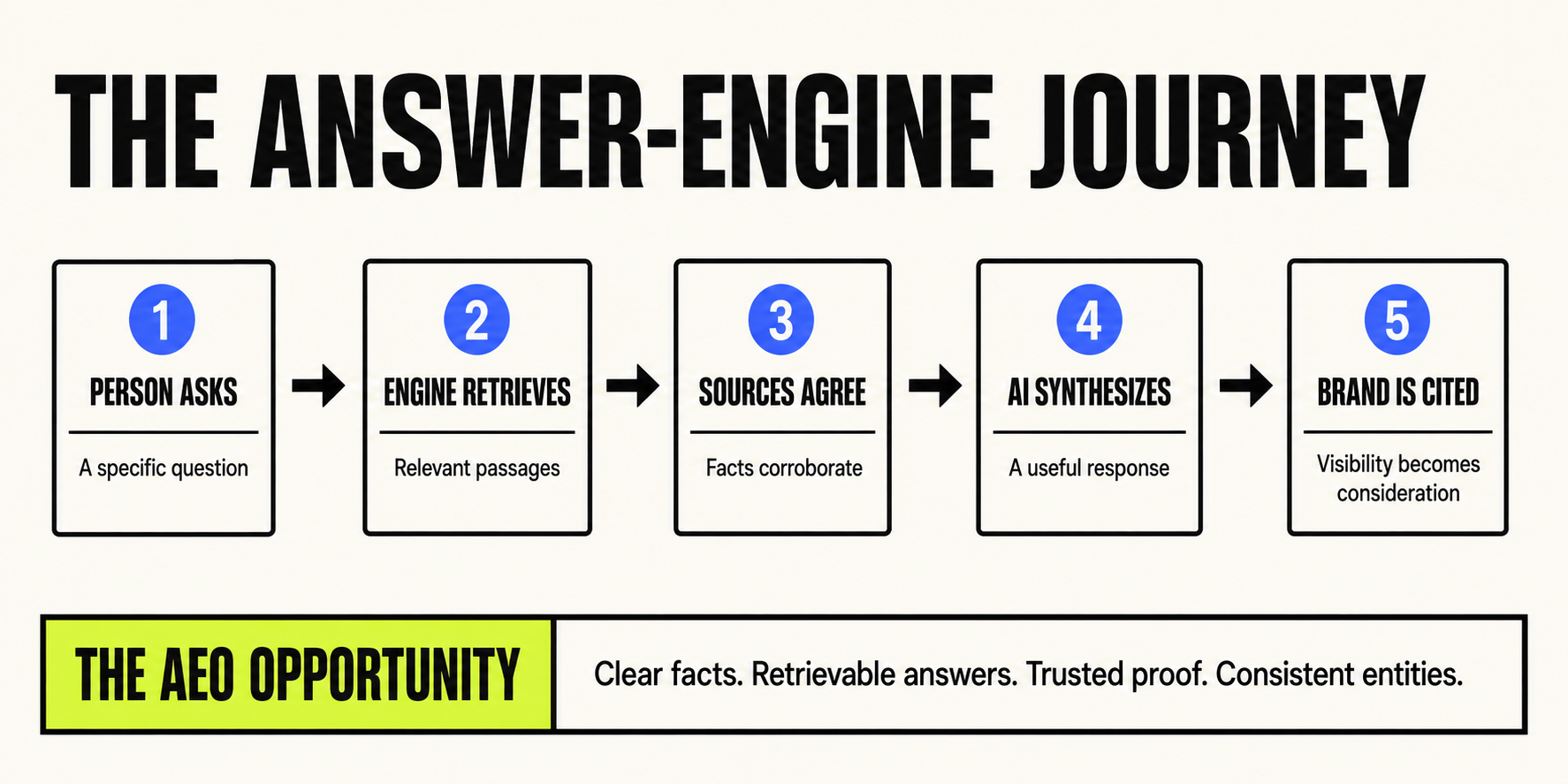
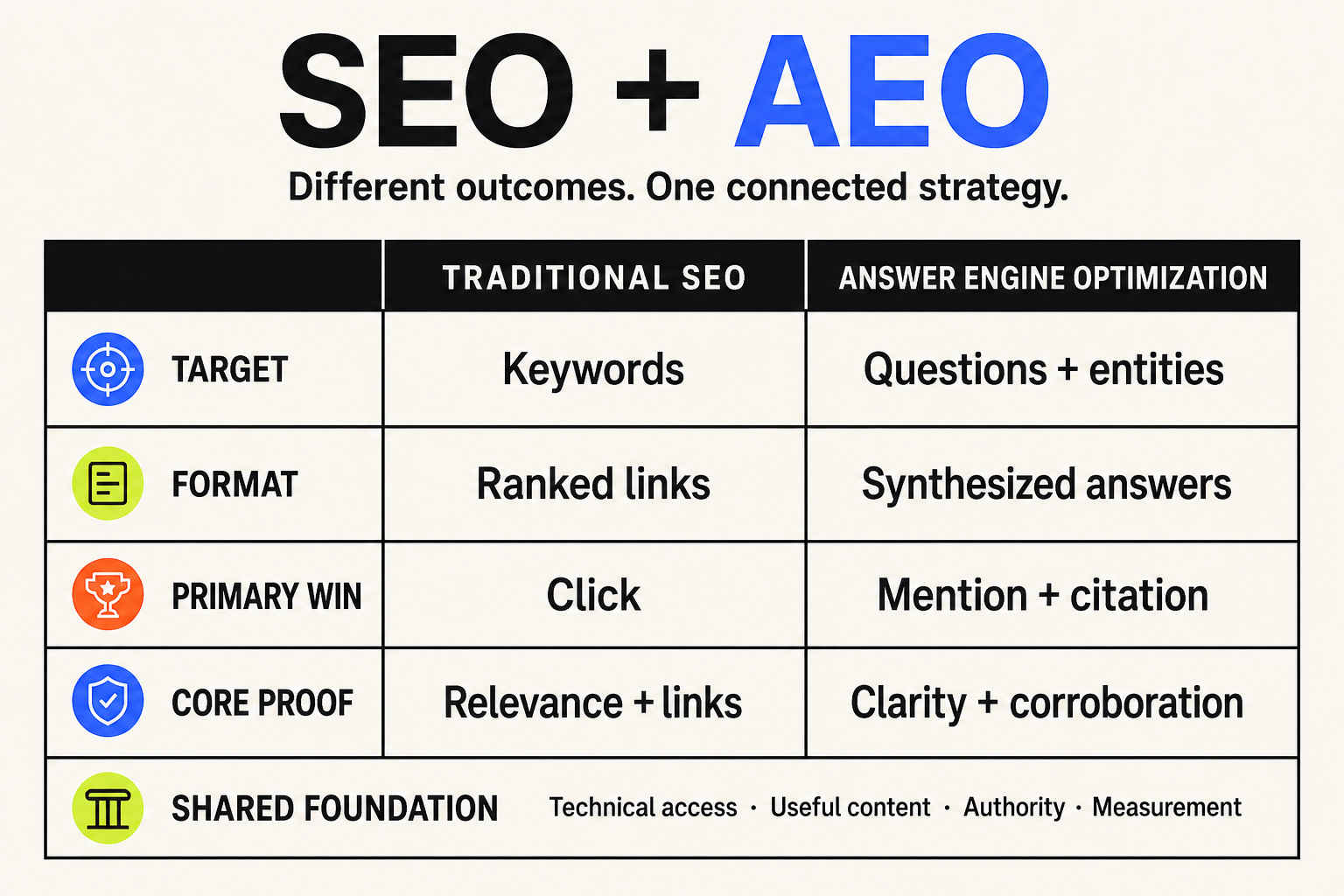
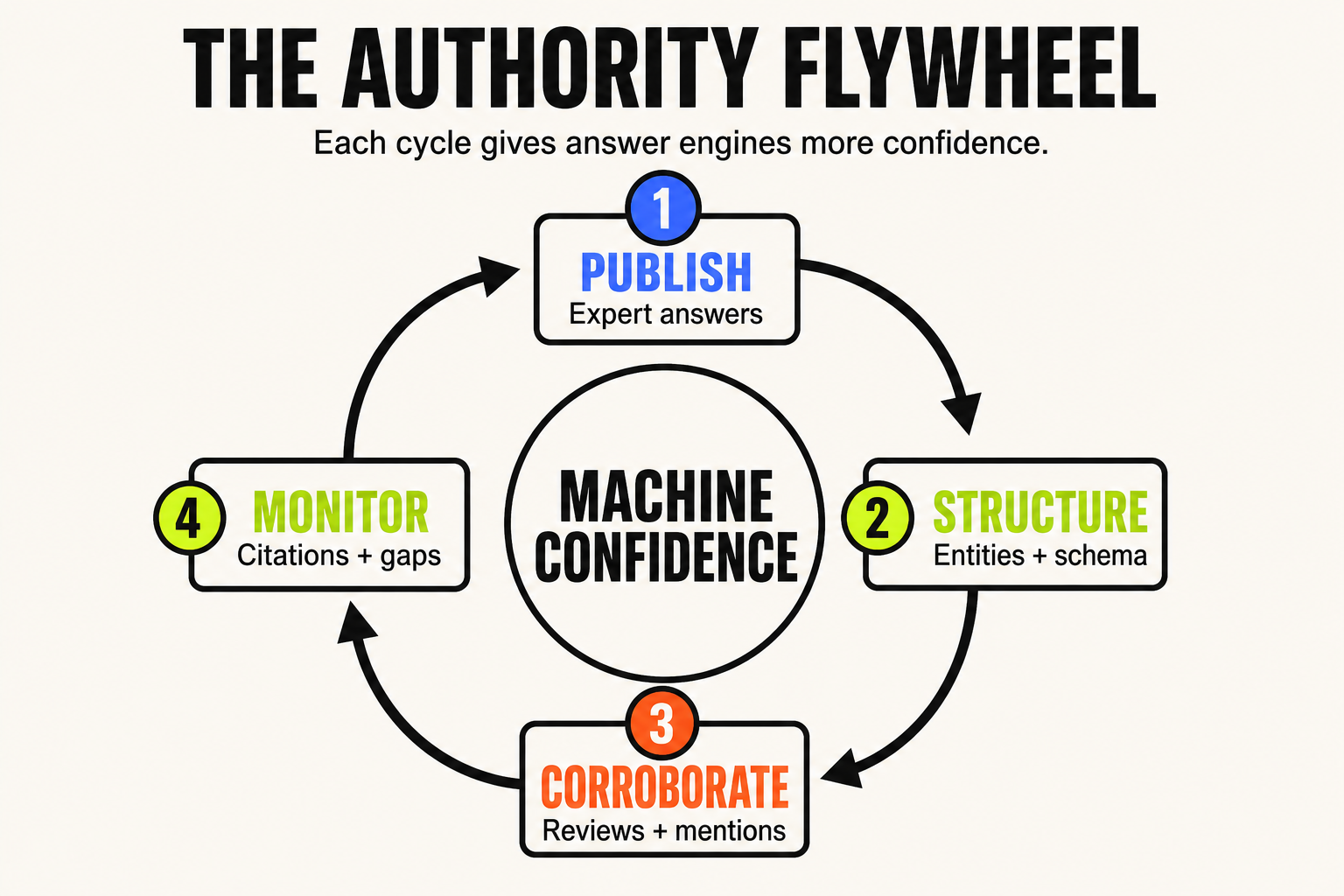
A practical operating loop for building and improving answer-engine visibility.
Measure how your brand appears across the major answer engines.
↗Connect customer questions to the entities, pages, and proof they require.
↗Create answer-first content, structured data, and consistent brand facts.
↗Track visibility, citations, sentiment, and competitive share over time.
↗Eighteen supporting guides turn the framework into a practical AEO operating system.
Explore all 18 guides →A practical introduction to AEO, how answer engines work, and what businesses should optimize first.
7 min read ↗02 / StrategyUnderstand where SEO, AEO, and GEO overlap—and how to organize them as one search visibility program.
8 min read ↗03 / CitationsA clear model for understanding retrieval, source selection, passage quality, and citation behavior.
9 min read ↗Review our ownership, author standards, editorial process, sourcing, fact-checking, corrections, privacy, terms, and accessibility commitments.
Open the Trust Center →These answers summarize the core methodology. Each topic links naturally into the deeper resource library and is kept visible so the page content and structured data agree.
Answer Engine Optimization, or AEO, makes a brand's information easier for search engines and AI assistants to discover, understand, verify, retrieve, and cite. It combines technical SEO, entity clarity, answer-first content, structured data, trustworthy evidence, and measurement.
SEO focuses on ranked search results, AEO on direct answers and citations, and GEO on representation inside generative responses. All three share a foundation of crawlable pages, clear intent, useful content, consistent entities, evidence, and authority.
Evaluate the platforms customers actually use, including Google Search and its AI features, ChatGPT search, Microsoft Copilot, Gemini, Claude, and Perplexity. Test them separately because retrieval sources, citations, personalization, location, and answer formats differ.
No. Accurate JSON-LD can clarify page type, authorship, organization relationships, images, breadcrumbs, and visible facts, but it cannot force rankings or citations. It should reflect strong public evidence, not replace authoritative content or reputation.
Measure repeated outcomes across a stable prompt set: brand mention rate, citation rate, cited landing pages, recommendation share, answer accuracy, sentiment, competitor visibility, and source overlap. Connect those observations to search impressions, referral visits, branded demand, assisted conversions, qualified leads, and revenue instead of relying on one AI response or a synthetic score.
There is no universal timeline. Technical fixes and factual corrections may be reflected relatively quickly, while new authority, third-party corroboration, entity understanding, and citation patterns can take longer. Establish a baseline, fix high-impact issues, publish meaningful improvements, and retest on a consistent schedule while documenting platform and market changes.
We use official documentation for technical claims and separate documented requirements from editorial interpretation. Platform behavior changes, so no page can promise a ranking, citation, or recommendation.