
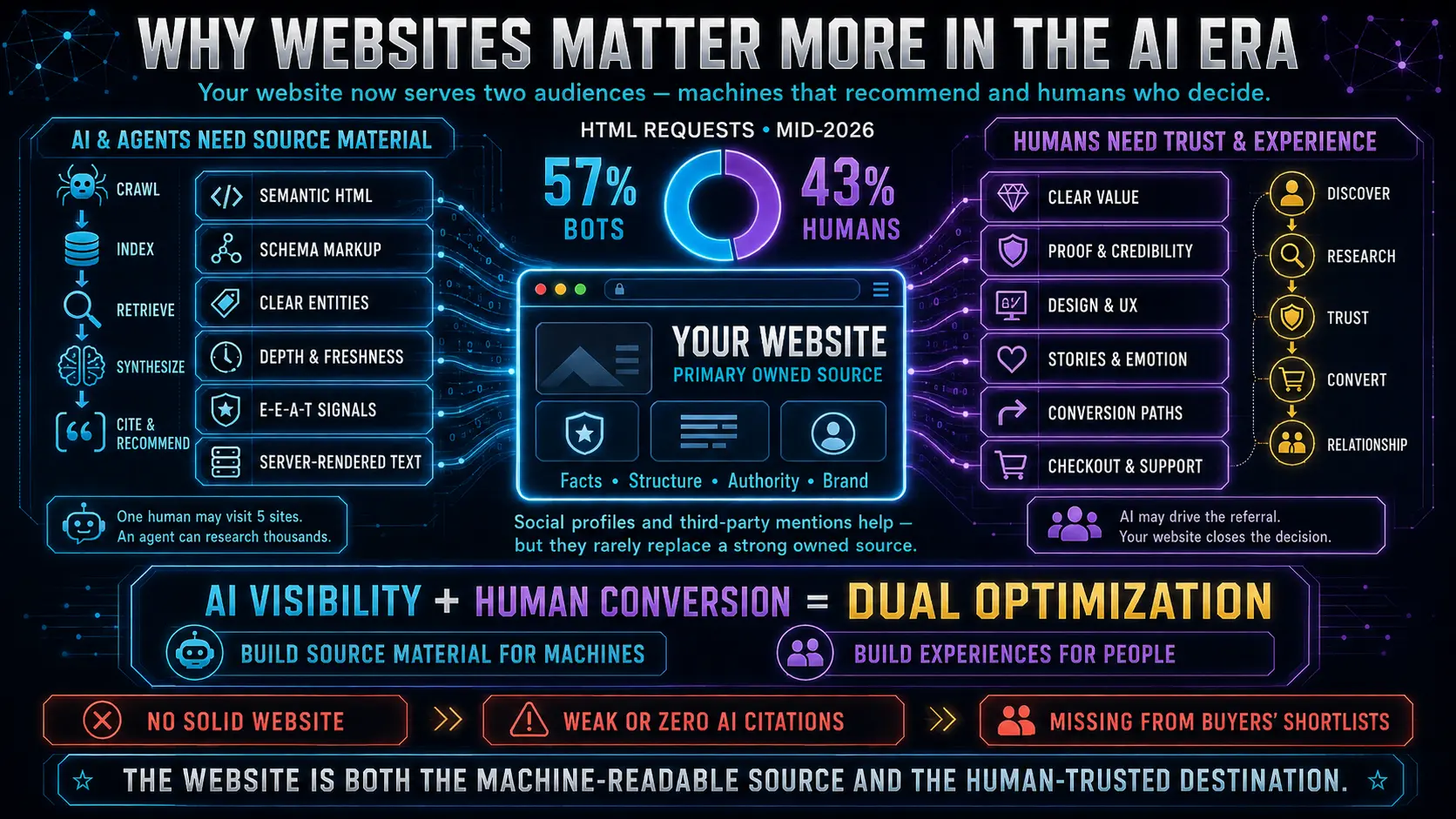
why websites matter in the AI era
Why websites matter in the AI era is best approached as a practical system designed to understand the website as both an evidence source and conversion destination. It combines technical accessibility, explicit entities, answer-first content, credible evidence, and measurement. The objective is not to manipulate an AI model; it is to make the most useful and defensible information easy to discover, understand, retrieve, verify, and represent accurately.
Key takeaways
- Center the page on one clear intent: understand the website as both an evidence source and conversion destination.
- Build coverage around owned media, AI crawler, machine-readable content, server-rendered text.
- Connect visible claims to accountable sources and the relevant Googlebot, OAI-SearchBot, Bingbot.
- Measure repeated outcomes and business impact instead of relying on a single AI response.
One owned source, two audiences
AI assistants need source material they can crawl, index, retrieve, interpret, and cite. People need clear value, proof, usable design, and a credible path to act. A strong website serves both without forcing either audience through a separate experience.
The request-share statistic shown in the infographic is a mid-2026 snapshot, not a fixed law of web traffic. Its strategic lesson is broader: automated agents are a material audience for public web content, while human trust and conversion remain essential.
Build source material for machines
Machine-readable does not mean machine-written. Use semantic HTML, server-rendered text, clear entities, descriptive headings, accurate structured data, and stable internal links. Explain important facts in direct language and keep dates, qualifications, and ownership visible.
- Crawlable pages with meaningful rendered text
- Clear entity, service, product, and location facts
- Depth and freshness appropriate to the topic
- Evidence of experience, expertise, and accountability
- Concise passages that remain clear when retrieved alone
Build decision experiences for people
An AI system may introduce the brand, but the website often carries the deeper evaluation. Visitors need proof, relevant examples, transparent policies, readable design, fast performance, and a conversion path that matches their intent.
Social profiles and third-party mentions can expand discovery, but they rarely replace a well-maintained owned source. The website is both the evidence base machines can cite and the destination where people decide whether to trust the business.
Create a machine-readable source of truth
Entity work starts with facts people can verify. Define the organization, its services, locations, responsible people, and areas of expertise in visible page content. Use one preferred name, stable canonical URLs, and consistent descriptions. Then use structured data to reflect those facts and connect them with durable identifiers.
For why websites matter in the AI era, important entities include Googlebot, OAI-SearchBot, Bingbot, Schema.org, Google Search Console, content management system. The purpose is disambiguation: helping search and answer systems distinguish the business from similar names and understand how its people, offerings, places, and published work relate. Markup should never claim a relationship that the page or reliable external evidence does not support.
Connect entities across the site and web
Give each important entity a clear home. Organization information belongs on accountable about and contact pages; services need focused explanations; real locations need useful local detail; articles need truthful authorship and dates. Use descriptive internal links so those relationships are visible to readers before expressing them in JSON-LD.
Reconcile the same core facts across major business profiles, industry directories, publishers, and reference sources. owned media, AI crawler, machine-readable content, server-rendered text, digital trust become meaningful only when the public evidence agrees. A large schema graph cannot compensate for contradictory addresses, outdated service descriptions, anonymous claims, or missing ownership information.
Validate meaning, not only syntax
A validator can confirm that JSON-LD parses, but it cannot confirm that a claim is true or strategically useful. Review rendered content and markup together. Check canonical URLs, stable @id values, dates, images, breadcrumbs, authorship, organization references, and page types. Remove properties that are speculative, duplicated, or invisible to users.
Measure whether systems describe the brand accurately, associate it with the intended topics, and select the right pages. Monitor branded search results, answer-engine responses, knowledge features, and citation destinations. Successful why websites matter in the AI era reduces ambiguity for people and machines; it is not measured by the number of schema properties shipped.
A 90-day implementation roadmap
During days 1–30, establish the baseline for why websites matter in the AI era. Inventory the pages, profiles, and third-party sources that currently shape the topic. Test the five FAQ questions in this guide across the platforms relevant to the audience. Record inaccurate facts, missing citations, weak landing pages, intent overlap, and technical access issues. Assign one accountable owner to every finding and preserve the original observations so later comparisons are meaningful.
During days 31–60, improve the evidence closest to the decision. Rewrite unclear openings, add appropriate qualifications, connect claims to primary sources, strengthen internal links, and make Googlebot, OAI-SearchBot, Bingbot, Schema.org explicit where they genuinely belong. Align titles, descriptions, headings, visible content, images, and structured data. Consolidate pages that compete for the same intent, but preserve distinct pages that answer a materially different audience need.
During days 61–90, publish the completed improvements, verify indexing, and repeat the benchmark. Compare changes in owned media, AI crawler, machine-readable content, server-rendered text with search impressions, cited URLs, qualified visits, and conversions. Document what changed, what did not, and which external factors may have influenced the result. Use that evidence to choose the next topic rather than expanding the program through unsupported assumptions.
What a strong result looks like
Success means the page gives a person a complete, accurate answer and gives a retrieval system a clear, verifiable source. The brand is described consistently, important entities are unambiguous, cited pages match the user's intent, and the next action is easy to understand. For why websites matter in the AI era, improvement should appear as a pattern across repeated tests and business outcomes—not as one favorable screenshot. Maintain the page when evidence changes, disclose limitations, and keep the public record stronger than the markup describing it. Review the result with editorial, technical, analytics, and customer-facing teams because each group sees different evidence gaps and can prevent a narrow optimization from damaging the overall experience.
Frequently asked questions
Do businesses still need websites when customers use AI?
The practical definition centers on why websites matter in the AI era: understand the website as both an evidence source and conversion destination. Treat it as a connected program involving accessible pages, clear entities, useful answers, and evidence that people and retrieval systems can verify. The exact implementation depends on the audience, query, market, and platform.
What do AI crawlers need from a website?
Start with the highest-value questions and the pages that should answer them. Confirm technical access, align each page to one intent, strengthen owned media, AI crawler, machine-readable content, and connect material claims to reliable evidence. Expand only after the core facts and conversion path are accurate.
Can social profiles replace an owned website?
Use the approach when it improves clarity for a reader as well as a machine. Googlebot, OAI-SearchBot, Bingbot can help reveal gaps, but no single platform should define the entire strategy. Keep visible content, metadata, internal links, and structured data consistent with one another.
How should a website serve people and machines?
No tactic can guarantee a ranking, citation, or recommendation. Avoid hidden content, invented credentials, unsupported schema, mass-produced pages, and mechanical keyword repetition. Durable performance comes from accurate source material, independent corroboration, a usable site, and repeated measurement across a representative query set.
Which website pages matter most for AI visibility?
Review results after meaningful site or market changes and on a scheduled cadence. Track conversion experience, brand source of truth, first-party data alongside leads or other business outcomes. Preserve the date, platform, prompt, and cited URLs so changes can be compared without confusing normal response variation with causation.
Related entities and concepts
Primary references
We use official documentation for platform and markup guidance, then separate those documented requirements from our editorial interpretation and observed testing.
This guide is educational and does not promise placement in any search or AI product. Platform behavior changes; verify current requirements before implementation. Our team reviews material claims, visible FAQs, links, and structured data together.